
Protein forms the most important part of every living organism. It is also the essential nitrogenous constituent in all the foods we eat. Protein is exceedingly complex in its structure and functions, and many of its reactions are still very mysterious. But this need not trouble you. In planning for your family always be sure to have sufficient proteins in your diet. This is basic to good nutrition. Why is the body so dependent on protein? For an answer, let us examine the body mechanism and how it functions.
VAST FAMILY OF CELLS
The human body is more or less like a vast family of cells, all with their own special work to do. Some cells are bundled together in the form of powerful muscles. Others are hard at work in the nervous system, busy flashing messages here and there as needed by the body. Still, others have the job of holding us together, and providing stability through our bones, joints and sinuses. On the surface of the brain, we have certain cells that enable us to think and plan for the future. Everything we do, every reaction taking place within us is carried out by one type of cell or another. This is life.
Just like the numbers of any good household, all these cells must be fed and cared for. How is this done? Through the things: we eat and drink, and in how we care for our selves. Eating and drinking bathing and resting, all are vitally important to health. What has all this to do with food? To a great extent, each cell in your body is dependent upon you to keep it alive. What you eat makes all the difference between life and death. From the foods you eat, each cell, whether in bone, muscle, nerve, or skin, build up its own particular type of protoplasm. This is the living jelly like material of which all cells are composed. Protoplasm is the basic material of which all living things, whether plants or animal are made. And this protoplasm is built up from the proteins within our diet. Bu this is not all. Protoplasm possesses within itself the remarkable power of movement, reproduction and growth. A baby grows from a single cell which is almost too small to be seen by the unaided eye. Yet, that single cell will multiply itself into enormous number of other cells of many different types and together they make up the human body.
The living cells draw nutrient from the fluids that flow all around them, fluids that are kept in constant motion by the heart. During the growing period, each cell enlarges to about double its normal size, then abruptly divides into two daughters cell each equal in size to the original living protoplasm which has now doubled in size and this carries on indefinitely as long as the individual continues to grow. When he is fully mature, this process of growth and division suddenly ceases and is not resumed except for the repair or replacing of cells worn out through injury or damaged by disease.
WHY PROTEINS ARE IMPORTANT
Need we ask why proteins are important in the diet? It is from proteins that the living protoplasm within the cell is built. This wonderful living material is constantly absorbing and expending energy. Part of this energy is needed for the growth of the cells itself. The rest is expended on the work the cell does, and the heat it produces. That is what keeps us warm and alive. And as long as we are alive and in good health, those cells of ours will maintain more or less the same temperature, regardless of the weather. To do this, they must have an adequate supply of proteins and carbohydrates. Proteins materials are built up first of all in plants and trees. Tiny factories in the leaves and roots are constantly at work, changing the simple chemicals of nature into more complex substances, such as proteins, carbohydrates, and fats, ready for use in the human body. Carbohydrates and fats provide energy for all the cells of the body, while proteins are needed for growth and repair of cells. Proteins are by far the most complex group of substance known to science today.
Fortunately, we don’t have to understand all about the chemistry of foods and cells before we eat our meal. We can leave that to the scientists, with all their ultramicroscopic and delicate equipment. The important thing is to be sure we have sufficient proteins in our own diet, for these are the food substances that build a strong and healthy body. Proteins are needed continually to repair worn out tissues. They are essential for building strong bones and muscle in growing children and are needed all through life. We cannot stay well unless we always have an adequate supply of protein in our diet.
AMINO ACIDS
Proteins are very complex substances and there are endless varieties of them. Each type of protein contains a certain number of “Building Block or amino acids always arranged in certain sequences according to the type of protein.
The more highly complex proteins have many more of these amino acids or building blocks. The arrangement of these amino acids is always important. Just the change of one or two tiny atoms in the proteins molecules may produce an entirely different substance. Some proteins such as albumin, or the white of an egg, are easily dissolved in water. Others such as globulin can only be dissolved in a dilute, salty solution. Both albumin and globulin are present in the blood stream, along with many other forms of proteins all of which are continually necessary for life.
All the proteins in the body are being continually changed and renewed. This renewal requires a good supply of protein in the diet at all times. Before they can be absorbed by the body, all the proteins in our foods must first be broken down into amino acids. This takes place in the same bowel. From these, fragments of proteins are carried to the liver by the blood stream, where they are changed and stored ready for future use. But in the tissue these fragments are finally combined into the type of protein needed by each particular kind of cell.
GOOD SOURCE OF PROTEIN
Proteins are found in almost all foods, but some contain far more than others. Richest Sources of Protein are whole Grain Cereals, Peas, beans, lentils, Peanuts, Soy Beans, Milk, Eggs, Cheese, Butter Milk, Meat and Fish. For various reasons, many families prefer a vegetarian diet. Because some kinds of meat are rather expensive, other families may find them beyond their means. Fortunately, a wise combination of vegetable and cereals can supply all the protein a person actually needs.
Milk and dairy products are among the best source of proteins, generally speaking, they are easily digested and absorbed by the body. Milk contains complete proteins and at the same time, provides calcium and phosphorus in just the right preparations for growing children and nursing mothers. But even with so good a food as milk, we must still add a word of caution. Milk is easily contaminated by diseased carrying germs, during the milking process and also while being stored. Therefore, all milk should be boiled or pastured before use, boiling for several minutes will quickly kill all harmful germs.
Meat is high in protein, but contains certain waste materials, which must be eliminated by the kidneys. This means extra work for the body, as well as trouble for those whose kidneys have been damaged by disease. There are many good reasons to live on a meat diet. However, vegetarians should be sure to get enough protein from other sources, such as GROUND-NUTS, PEAS, BEANS, PULSES, BENGAL GRAM, WHOLE-GRAIN CER- EALS AND MILK PRODUCTS. Also green leaves are a useful source of protein. Their benefit is much greater than one would suppose from the percentage of protein they actually contain. The reason is that although the percentage is low, the biological value of a vegetarian diet is considerable when such green leaves, raw or cooked are included daily.
SOY BEANS ARE VALUABLE.
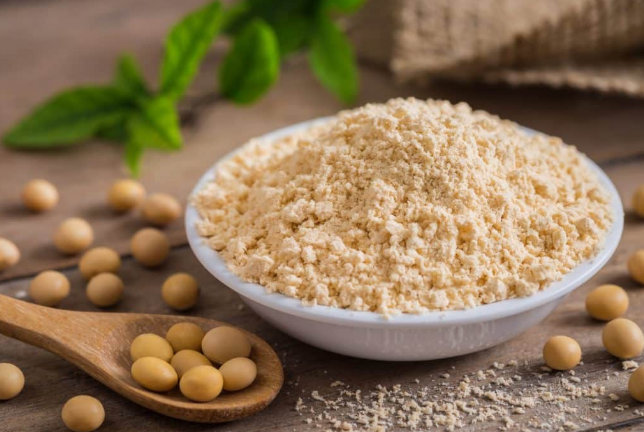
One of the richest sources of protein is the soybean. This simple food contains complete protein in itself. The soybean has been cultivated in China and Japan for centuries Soybeans actually contain twice as much protein, ounce for ounce, as meat and four times as much as egg! Soybeans also contain a high quality vegetable oil that has no cholesterol in it. Soybean oil contains lecithin too which is of value in controlling the level of cholesterol within the body. Soybeans are low in carbohydrates, so that diabetic patients can use them freely. Soybeans are highly alkaline and in addition contain all the important vitamins. Sprinted soybeans are used in many parts of Asia. They are an excellent source of vitamin. They are also rich in vitamins A and B Complex. Balsas who are allergic to Coz milk can usually take soybeans milk without any trouble. In some countries, a number of foods are made from the soy- beans. THESE INCLUDE BA- KED BEANS, CANNED OR FROZEN GREEN BEANS, SPROUTS, SOY-BEANS MILK AND CHEESE, VEGETABLE shortening, margarine and salad oil; soybeans are also being used in ice cream and sweetmeats. Soy breakfast foods, soy sauce, and say flour, different types of soy beans are being produced for these purposes. Modern nutritionist and food chemists are busy in many areas searching for new ways of using this important protein food. Without doubt, the soybeans is an excellent answer to the problem of feeding an over populated world. It is one of our very best foods, nature’s great gift to man. (MZ) BY C.A UZOKA